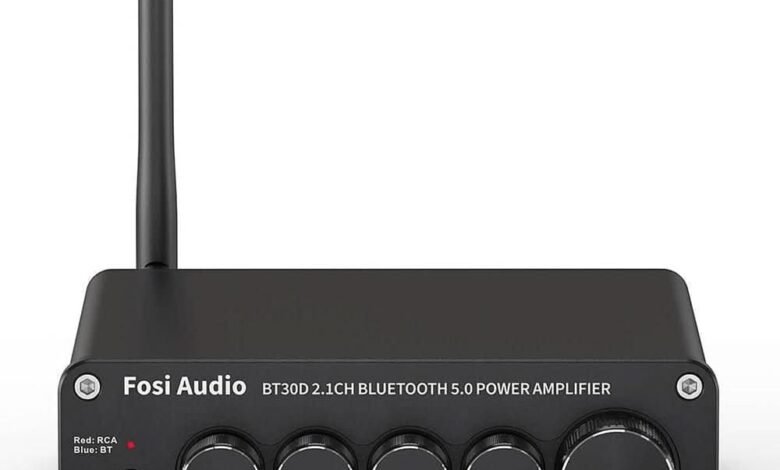
A passive subwoofer is a speaker with no amplifier of its own. It produces deep bass, but it cannot do so without external power, and that power has to come from a dedicated passive subwoofer amplifier. Understanding why the subwoofer needs its own amplifier, and how to choose one, is the key to bass that is deep, tight and controlled rather than boomy and vague.
Passive Versus Active Subwoofers
Subwoofers come in two kinds. An active subwoofer has an amplifier built into its cabinet, so you connect it to a line-level output and it does the rest. A passive subwoofer has no built-in amplifier, so it needs an external one to drive it.
Passive subwoofers are often chosen by listeners who want flexibility. They let you pick the amplifier separately, upgrade it later, or drive several subwoofers from one amplifier. They are also common in custom installations, where the amplifier sits in a rack away from the listening room. That flexibility is their strength, but it means the amplifier choice matters.
Why Bass Needs So Much Power
Low frequencies demand far more power than midrange or treble. Moving a large bass driver back and forth to produce deep notes takes serious current, and the amplifier must deliver it cleanly and without hesitation. A passive subwoofer amplifier is built for exactly this job, with a power supply designed to handle sustained low-frequency demands.
An ordinary stereo amplifier can sometimes drive a passive subwoofer, but it is rarely ideal. A dedicated passive subwoofer amplifier usually includes a low-pass filter, which sends only the lowest frequencies to the subwoofer, and controls for level and crossover that make integration with the main speakers far easier.
Matching Power to the Subwoofer
Start with the subwoofer’s power handling and impedance, both found in its documentation. The amplifier should deliver enough power to drive the subwoofer comfortably at your normal listening level, with headroom in reserve for sudden peaks. Too little power makes the bass sound weak and strained, while far too much power risks damage if the volume is pushed carelessly.
Impedance matters too. Many passive subwoofers are rated at four ohms, which asks more of an amplifier than an eight-ohm load. Check that the amplifier is rated for the subwoofer’s impedance, and that it can deliver its power into that load without overheating.
Crossover, Level and Phase
A passive subwoofer amplifier usually offers three controls that make the difference between good bass and great bass. The crossover setting decides where the subwoofer takes over from the main speakers. The level control balances the subwoofer’s volume against the rest of the system. The phase control aligns the subwoofer’s output with the main speakers so their sound waves reinforce rather than cancel each other.
Set the crossover near the point where your main speakers begin to lose bass, then adjust the level until the bass feels like part of the music rather than a separate effect. Small adjustments make a large difference, so take your time.
5 Steps to Set Up a Passive Subwoofer Amplifier
- Check the subwoofer’s power handling and impedance before choosing.
- Connect the amplifier to a subwoofer output or a low-level feed from your system.
- Set the crossover where your main speakers begin to lose bass.
- Adjust the level until the bass blends naturally with the music.
- Fine-tune the phase control for the fullest, most even sound.
Placement: The Other Half of Good Bass
Even the best passive subwoofer amplifier cannot fix poor placement. Bass behaves differently from other frequencies, and the same subwoofer can sound boomy in one corner and tight in another. Try the subwoofer in different positions, listening for the spot where the bass feels even and controlled. Corners reinforce bass, which can help a small subwoofer, but they can also make it sound muddy, so experiment before settling.
Two Subwoofers Instead of One
Many listeners eventually add a second subwoofer, and the reason is not louder bass but smoother bass. A single subwoofer interacts with the room in ways that create peaks and dips, so some notes boom while others disappear. Two subwoofers, placed in different parts of the room, even out those variations and produce a more consistent sound across the seating area.
A passive subwoofer amplifier that can drive two subwoofers makes this upgrade straightforward. The same crossover and level controls apply, and the result is bass that sounds even wherever you sit. It is a worthwhile step once the first subwoofer is properly set up and you want the next level of refinement.
Frequently Asked Questions
Can I use a normal stereo amplifier for a passive subwoofer?
Sometimes, but a dedicated passive subwoofer amplifier is usually better. It provides the power bass needs, plus crossover and level controls that make blending with your main speakers much easier.
How much power does a passive subwoofer amplifier need?
It depends on the subwoofer, the room and how loud you listen. Check the subwoofer’s power handling and choose an amplifier with comfortable headroom above your normal listening level.
Do I need one amplifier per subwoofer?
Not necessarily. Some passive subwoofer amplifiers can drive two subwoofers, and a single amplifier can serve a pair if its power and impedance ratings allow. Check the specifications before connecting more than one.
See also: Transforming Business Operations Through Modern Technology
Final Thoughts
A passive subwoofer amplifier is the engine behind deep, controlled bass. Choose one that matches your subwoofer’s power and impedance, use its crossover and level controls to blend it with your main speakers, and take time over placement. When it all comes together, the bass stops drawing attention to itself and simply becomes part of the music, which is exactly how it should be.