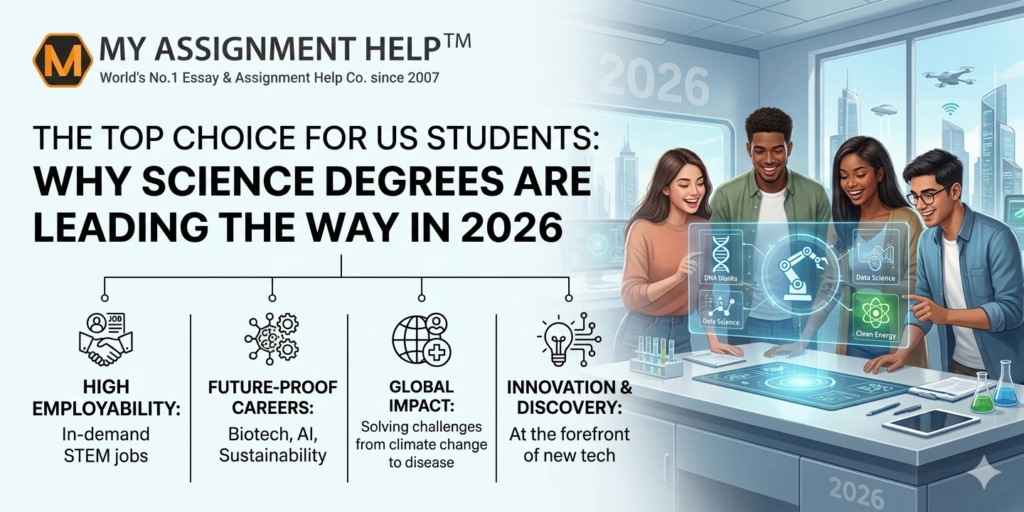
The American educational landscape is undergoing a profound transformation. While the value of a four-year degree has faced intense scrutiny in recent years, one sector continues to defy the skepticism: Science, Technology, Engineering, and Mathematics (STEM). As we navigate 2026, pursuing a science degree is no longer seen just as an academic pursuit; it is viewed by students and parents alike as the most secure investment in a volatile, AI-driven economy.
This shift isn’t accidental. It is driven by the convergence of rapid technological advancement, critical global challenges like climate change, and a robust U.S. labor market that is explicitly rewarding scientific literacy. Today’s students are pragmatic; they are seeking majors that offer not only intellectual fulfillment but also high starting salaries, job security, and the agency to solve real-world problems. The laboratory, it seems, has become the incubator for the leaders of tomorrow.
The Innovation Imperative: Fueling the 21st Century Economy
The primary catalyst behind the surge in science enrollments is the accelerating pace of innovation. In 2026, we are witnessing the maturation of technologies that were only theoretical a decade ago. From the mainstream integration of CRISPR gene editing in personalized medicine to the localized deployment of small modular nuclear reactors (SMRs) for clean energy, science is at the forefront of every major industry.
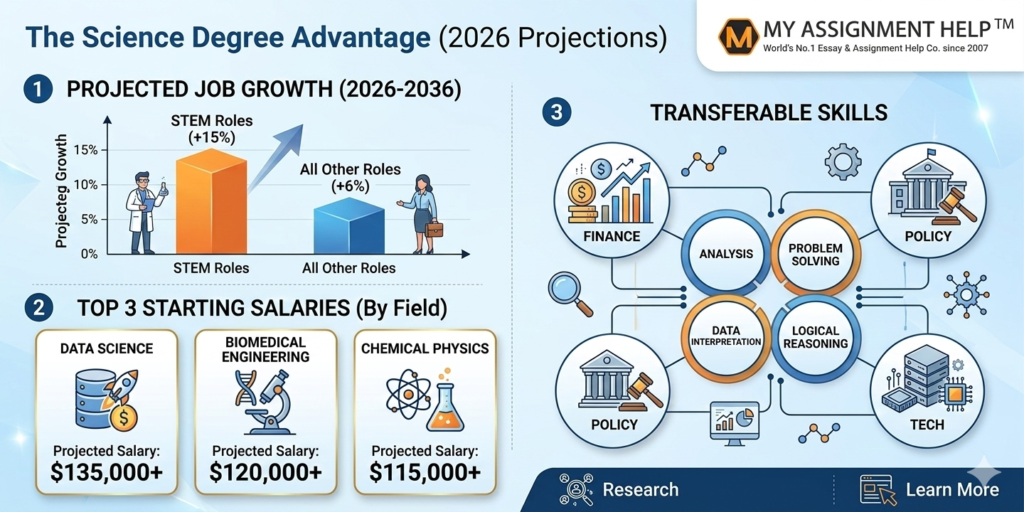
According to recent projections from the U.S. Bureau of Labor Statistics (BLS), STEM occupations are expected to grow over two times faster than non-STEM occupations through 2031. This disparity is creating a “talent war,” where major U.S. corporations and research institutions are actively recruiting students before they even graduate. This intense demand often places immense pressure on undergraduates. Mastering the prerequisites—from organic chemistry to quantum mechanics—is grueling. Consequently, many students find that utilizing reliable science assignment help is an essential strategy to manage the academic workload and secure the high GPAs required by top-tier recruiters. This support allows students to deeply understand complex concepts rather than just memorizing them for an exam, bridging the gap between theoretical knowledge and practical application.
Furthermore, the integration of Artificial Intelligence (AI) has not replaced scientists; it has empowered them. In 2026, a biology degree, for instance, often includes coursework in bioinformatics or computational modeling. AI is being used as a tool to accelerate drug discovery and analyze massive datasets, making scientific roles more dynamic and intellectually stimulating.
The Purpose-Driven Generation: Solving Global Challenges
Beyond financial security, Gen Z and Gen Alpha—who make up the 2026 student body—are deeply motivated by societal impact. The traditional corporate ladder is less appealing than the prospect of contributing to tangible solutions for existential threats.
This is most evident in the surge of interest in Environmental Science and Geosciences. With the U.S. committing to aggressive net-zero targets, the demand for experts in carbon capture, renewable energy integration, and ecological restoration is at an all-time high. Students are choosing these fields because they offer a direct pathway to combatting the climate crisis. For those passionate about this area, exploring cutting-edge climate change research topics can provide inspiration for thesis projects or future career specializations. This connection to purpose makes science degrees exceptionally appealing to a generation that values authenticity and social responsibility.
Data-Driven Decisions: The Financial Reality
When analyzing why science degrees are the top choice, the financial data provides compelling evidence. In an era where student loan debt is a major concern, the return on investment (ROI) of a degree is paramount.
The National Association of Colleges and Employers (NACE) Winter 2024 Salary Survey highlighted that STEM majors consistently dominate the top salary brackets for new graduates. By 2026, this trend has only solidified. A graduate with a degree in Biochemistry, Data Science, or Aerospace Engineering can expect a starting salary significantly higher than the national average for all college graduates.
Moreover, the versatility of a science degree is often overlooked. The analytical, problem-solving, and data-interpretation skills developed in a rigorous B.S. program are highly transferable. In 2026, “science hubs” like Boston, San Francisco, and Austin are seeing science graduates recruited not just by biotech firms, but also by venture capital funds (to vet new tech) and policy think tanks. A science degree is, therefore, seen as a flexible asset rather than a rigid path.
See also: How Pro Se Bankruptcy Filings Can Impact Your Credit Score In Florida
The Rise of Interdisciplinary Sciences
Another factor contributing to the popularity of science is the breaking down of traditional academic silos. In 2026, the most exciting degree programs are often interdisciplinary.
Universities are offering majors like Neural Engineering (combining neuroscience, biology, and electrical engineering) or Astrobiology. These programs cater to students who have diverse interests and want to work at the cutting edge where different fields collide. This interdisciplinary approach mirrors the real world, where complex problems are rarely solved by one discipline alone.
This trend is also reflected in the updated K-12 curriculum in the U.S., which emphasizes integrated science and engineering practices. Students arriving at college in 2026 are already accustomed to thinking cross-functionally, making these new science degrees a natural and exciting continuation of their education.
Conclusion
The dominance of science degrees in 2026 represents a pragmatic realignment of American higher education with the realities of the global economy and the aspirations of a new generation. By combining intellectual challenge with financial stability and the opportunity for profound social impact, science degrees have rightly earned their place as the top choice for students looking to not only succeed in the future but also to shape it. The laboratory bench has truly become the ultimate launchpad for a meaningful career.
Key Takeaways
- Economic Drivers: High demand in an AI-driven economy is making STEM degrees a secure financial investment with a high ROI.
- Job Growth: BLS data confirms that STEM occupations are growing faster than any other sector in the U.S. labor market.
- Societal Impact: A purpose-driven generation is turning to sciences to solve critical global issues like climate change.
- Academic Support: The rigorous curriculum often requires strategic use of academic support services like science assignment help to manage complex coursework.
- Versatility: The analytical skills gained in a science degree are highly transferable to diverse industries, including finance and public policy.
Frequently Asked Questions (FAQ)
Q: Are science degrees only for students who want to become doctors or lab researchers?
A: No. In 2026, science degrees are highly versatile. Graduates work in data science, policy analysis, patent law, technical writing, and business consulting, using the strong analytical skills they developed.
Q: How difficult are science degrees in 2026?
A: They remain challenging, requiring strong dedication and mathematical aptitude. However, the curriculum has become more integrated with technology (like AI), and universities offer extensive academic support, including peer tutoring and online science assignment help.
Q: Which science degree offers the best job security?
A: Currently, degrees that intersect with data analysis and biology, such as Bioinformatics or Data Science, are seeing exceptionally high demand. Environmental science and renewable energy specializations also offer significant stability.
Q: How can I find inspiration for a science thesis topic?
A: Looking into emerging global issues is key. Reviewing resources on climate change research topics or recent advancements in biotechnology can often provide the necessary spark for a comprehensive research project.
About The Author
Dr. Eleanor Vance is a Senior Content Strategist at MyAssignmentHelp.com. With over 15 years of experience in higher education and a Ph.D. in Molecular Biology from Johns Hopkins University, she specializes in analyzing educational trends and workforce readiness in the STEM fields. Dr. Vance has published several papers on K-12 STEM integration and frequently consults on curriculum development. At MyAssignmentHelp, she is dedicated to creating data-driven content that helps students navigate the complexities of their academic journeys, ensuring they have access to the resources and support needed to thrive in their scientific studies.