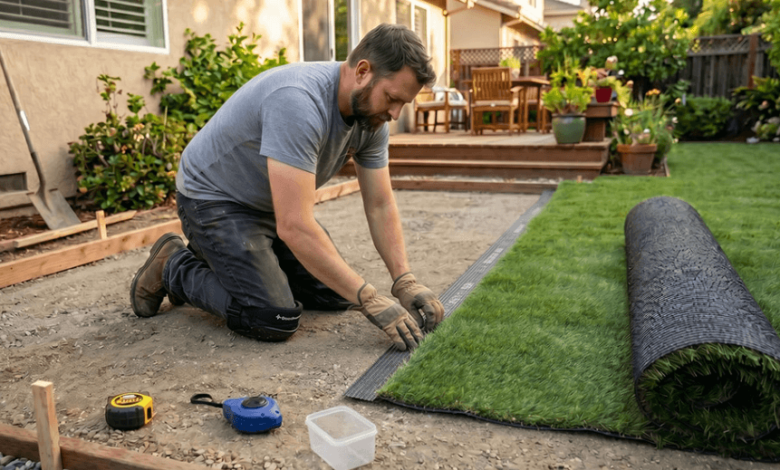
Working out how much turf a backyard actually needs is one of the most common questions homeowners face before placing an order, and getting it wrong can be a costly mistake.
Starting with an accurate measurement
Measuring the area to be turfed in square metres, rather than estimating by eye, is the essential first step before requesting a quote from any local supplier.
For irregularly shaped yards, breaking the space into smaller rectangular sections and adding the measurements together gives a far more accurate total than a rough guess.
A basic tape measure and a piece of graph paper are usually enough to sketch out even a fairly complex yard shape with reasonable accuracy.
Measuring twice and recording the numbers as you go avoids the common mistake of forgetting a section partway through a larger, more complicated yard.
Accounting for awkward areas
Local providers of turf supplies Hervey Bay can help measure trickier sections, such as curved garden beds or narrow side yards, that are easy to miscalculate when working alone.
Areas around trees, garden beds, and paving should be subtracted from the total area, since turf is not needed in these particular sections of the yard.
Awkward corners and narrow strips are also where homeowners most commonly under-order, since these small sections are easy to overlook when measuring quickly.
Why a buffer amount matters
Most suppliers recommend ordering a small buffer above the exact measured area, typically around five to ten percent, to account for cutting and wastage during laying.
Without this buffer, an unexpected shortfall partway through laying can mean waiting on a top-up order, which risks a mismatch in freshness between the two batches.
How turf is typically sold
Turf is generally sold by the square metre, either as individual rolls or slabs, with minimum order quantities varying between different local suppliers in the area.
Checking the exact roll size a supplier uses helps with more precise planning, since roll dimensions can vary slightly between growers and suppliers.
Some suppliers also offer a measuring service as part of a quote, which is worth asking about if a yard is particularly large or complex.
Comparing minimum order quantities across a few suppliers is also worth doing, since a small yard may fall below one supplier’s threshold but not another’s.
Asking how far in advance an order needs to be placed helps avoid a scramble later, particularly heading into the busier spring laying season.
Considering the shape of the yard
Long, narrow yards or those with multiple garden beds often require more careful planning than a simple rectangular block to minimise offcuts and unnecessary wastage.
A rough sketch of the yard with measurements marked out makes it much easier for a supplier to provide an accurate quote quickly over the phone or online.
Photographing the yard from a few angles alongside the sketch can also help a supplier spot potential access issues before delivery day arrives.
Noting the location of taps and hose access around the yard at this stage also helps with planning the watering routine once turf finally arrives.
Yards on a slope or split across multiple levels are worth measuring level by level, since a single combined figure can hide meaningful differences in each section’s needs.
Budgeting for the full project
Just as clear, targeted SaaS product marketing avoids wasted spend on the wrong audience, accurate turf measurement avoids paying for far more product than a yard actually needs.
Delivery costs and any site access fees should also be factored into the overall budget, since these can vary depending on how far turf needs to be carried on site.
Getting a full, itemised quote upfront, rather than a rough verbal estimate, makes it much easier to compare pricing fairly between different local suppliers.
Factoring in the cost of any soil preparation or levelling work alongside the turf itself gives a more complete and realistic picture of the total project budget.
See also: Commercial Resprays Telford – Giving Business Vehicles a Road Presence
Getting a second opinion on measurements
For larger or more complex yards, having a supplier visit in person to measure and quote directly reduces the risk of a costly miscalculation later on.
This is particularly worthwhile for properties with significant slope, since sloped areas can require slightly more turf than the flat measurement alone would suggest.
A short site visit also gives a supplier the chance to flag any access issues, such as narrow side gates, that could affect delivery on the day.
Ordering with confidence
Taking the time to measure carefully, add a sensible buffer, and confirm details directly with a local supplier makes the ordering process considerably less stressful overall.
A well-measured order also means turf arrives in a single, matched batch, giving the new lawn the very best possible start once it finally goes down.
For homeowners tackling this for the first time, a quick call to a local supplier before finalising any measurements is often the easiest way to avoid a costly mistake.
That small amount of upfront care consistently makes the difference between a stressful, error-prone order and a smooth, well-planned one from start to finish.
With accurate measurements and a sensible buffer in hand, ordering turf becomes a straightforward final step rather than a source of lingering uncertainty.
Most local suppliers are happy to talk homeowners through the measuring process over the phone, so there is little reason to feel unsure about getting started.
A carefully measured order sets the whole project up for success, from the very first delivery through to a thick, healthy lawn a few months down the track.
Taking these few extra steps before placing an order is a small price to pay for a backyard upgrade that goes smoothly and looks great from the very beginning.
In the end, a little patience during the planning stage is what turns a simple turf order into a lawn the whole household can enjoy for years.